

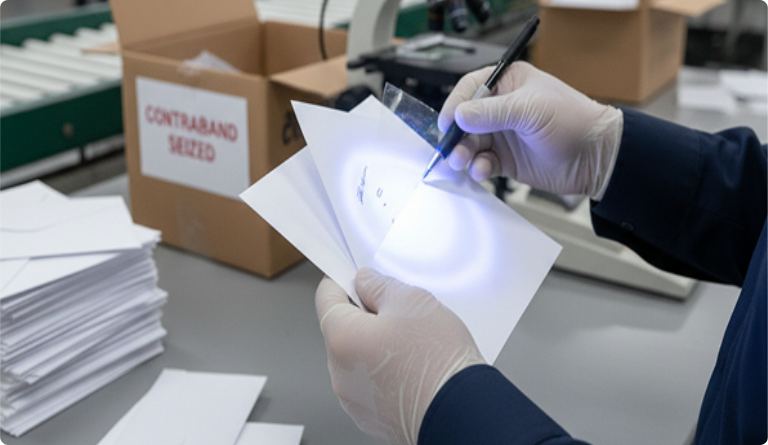
Mail contraband has changed.
Years ago, the biggest concerns were physical inserts—hidden items, altered envelopes, or prohibited images. Today, a growing concern is that contraband can be introduced through the materials themselves: paper, ink, adhesives, and coatings that are difficult to detect in a high-volume workflow.
This matters because it doesn’t just impact inmates—it can impact staff safety, facility security, and operational cost.
The Inmate Photos® Facility Partnership Program addresses this risk for covered categories by replacing public-origin mail with controlled-origin print fulfillment: content is created digitally, facility rules are shown before submission, content is screened before printing (AI screening + facility oversight options), and facilities receive standardized physical output produced in a controlled environment.
If you want the full workflow first, see:
Secure Print Fulfillment for Correctional Mail: How It Works
Why public-origin mail is the highest-risk input
Public-origin mail can be “unknown” in multiple ways:
- unknown chain of custody
- unknown paper, ink, adhesives, coatings, and additives
- unknown tampering risk before arrival
- inconsistent content rule compliance
- limited attribution in many traditional workflows
Mailrooms are expected to catch every issue under time pressure. That’s a hard standard—especially when some risks are not obvious to the eye.
Common ways contraband enters through mail today (high level)
Important note: facilities should use their own training and official guidance for operational procedures. This section is for awareness, written at a high level, not a “how-to.”
1) Drug-saturated paper (letters, cards, and printed sheets)
One modern pattern reported across corrections is the use of paper as a carrier, where illicit substances are applied to a page. This can be difficult to detect visually and may create staff exposure risk during handling and sorting.
2) Concealment in stamps, envelopes, and layered paper components
A common pathway involves small layered components—especially stamps and envelope areas—where substances or contraband can be concealed behind layers. These components are thin, common, and difficult to screen consistently at scale without adding significant handling time.
3) Coated or treated mail pieces (adhesives, coatings, and layers)
Mail can include layers—labels, stickers, tape, glue, lamination, or coatings—that complicate inspection and may be used to conceal or carry prohibited substances.
4) Hidden contraband in physical inserts
The “classic” method still exists: items hidden in envelopes, seams, folds, greeting card layers, or behind photos.
5) Policy evasion through volume and inconsistency
Even when items are not “clever,” volume can overwhelm mailrooms. A small percentage of noncompliant items becomes a constant operational drain.
6) Weak attribution and repeat attempts
When identity is weak, repeat violations can continue with minimal friction—especially when families don’t understand why something was rejected.
Why screening after mail arrives isn’t enough
Most facilities are forced into a reactive posture:
- Accept public-origin mail
- Inspect as best as possible
- Reject what violates policy
- Manage staff exposure risk
- Repeat every day
That’s not a failure of facilities—it’s a structural problem in the input.
A safer structure is to reduce risk before paper exists for covered categories.
How controlled-origin print fulfillment reduces risk (for covered categories)
The Inmate Photos® model changes the input.
1) Facility rules are shown before submission (prevention first)
Before a sender uploads images or submits content, they see facility-specific rules explaining what will not be accepted. Clear expectations reduce preventable violations and reduce “trial-and-error” resubmissions.
2) Content is created digitally (not mailed as unknown paper)
Senders compose letters and upload images through an account-based platform (web/app). This supports clearer attribution and reduces “unknown sender” issues compared to traditional paper mail.
3) Screening happens before printing (AI screening + facility oversight options)
Inmate Photos® screens content before printing, aligned to facility-defined rules. This reduces the number of policy-violating items that would otherwise be printed and delivered.
For facility control details, see:
Facility-Controlled Screening
4) If content is flagged, the sender can self-correct (hold + replace)
If screening determines that one or more items don’t meet facility guidelines, the order is placed on hold and the sender receives an email with a secure link to replace the flagged item(s).
If the sender doesn’t take action within the allowed window, the order can proceed without the flagged item(s), keeping fulfillment predictable while enforcing facility standards.
For a focused explanation of how this reduces rejects, see:
Reducing Mail Rejections: How Pre-Print Screening + Sender Self-Correction Works
5) Output is standardized and produced in a controlled environment
For routed categories, facilities receive standardized physical output printed under consistent processes rather than unknown public-origin paper, ink, adhesives, and layered components.
6) Staff handling risk is reduced for routed categories
Because public-origin paper is replaced by controlled-origin output for covered categories, staff spend less time handling unknown materials from the public for those categories.
Important boundary: legal/privileged/court mail stays in-house and is not routed through the program. See:
Legal & Privileged Mail Stays In-House
The operational benefit facilities actually feel
This model is designed to produce practical outcomes:
- fewer policy-violating items reaching the facility (for routed categories)
- fewer rejects and repeat attempts
- less staff time spent on rework
- better sender attribution and pattern visibility (email; phone number in some cases; facility-level pattern signals)
If you want the broader “no cost” structure, see:
Safety & Security at No Cost
If you want implementation speed context, see:
Go Live Fast
What this does NOT change (important boundaries)
Legal/privileged/court mail stays in-house
Inmate Photos® does not handle legal, privileged, or court mail.
Books are excluded from the program
Books are excluded from the Inmate Photos® Facility Partnership Program. Book delivery should continue through the facility’s standard process and approved sources, consistent with facility policy.
This is not a scanning service
Facilities receive physical output and distribute it using existing procedures—no tablets or kiosks required. For a direct comparison, see:
Secure Print vs Mail Scanning
From our operations team (why upstream control beats downstream rejection)
Inmate Photos® has fulfilled 500,000+ orders, delivered 3+ million photos, and operated for 6+ years.
At scale, it becomes clear that:
- downstream rejection is expensive (time, friction, repeat attempts)
- upstream prevention reduces rework
- screening before print + sender self-correction reduces repeat violations
- consistent outputs reduce surprises
That’s why the program focuses on controlled-origin printing for routed categories rather than accepting unknown public-origin paper mail.
Operational takeaways for facility leaders
- Identify which non-privileged categories create the most risk and workload today
- Route those approved categories through controlled-origin print fulfillment
- Show facility rules before submission to reduce preventable violations
- Use screening before print to reduce policy-violating items before paper exists
- Use hold + replace so senders correct issues without facility staff burden
- Keep legal/privileged/court mail in-house as a separate lane
- Use sender attribution and pattern visibility responsibly for enforcement
- Book a demo to map your policy into a clean rollout plan
Book a demo
If your facility wants to reduce contraband risk through mail for non-privileged personal correspondence and approved products—without tablets or kiosks—controlled-origin secure print fulfillment can be a major safety and operational win.